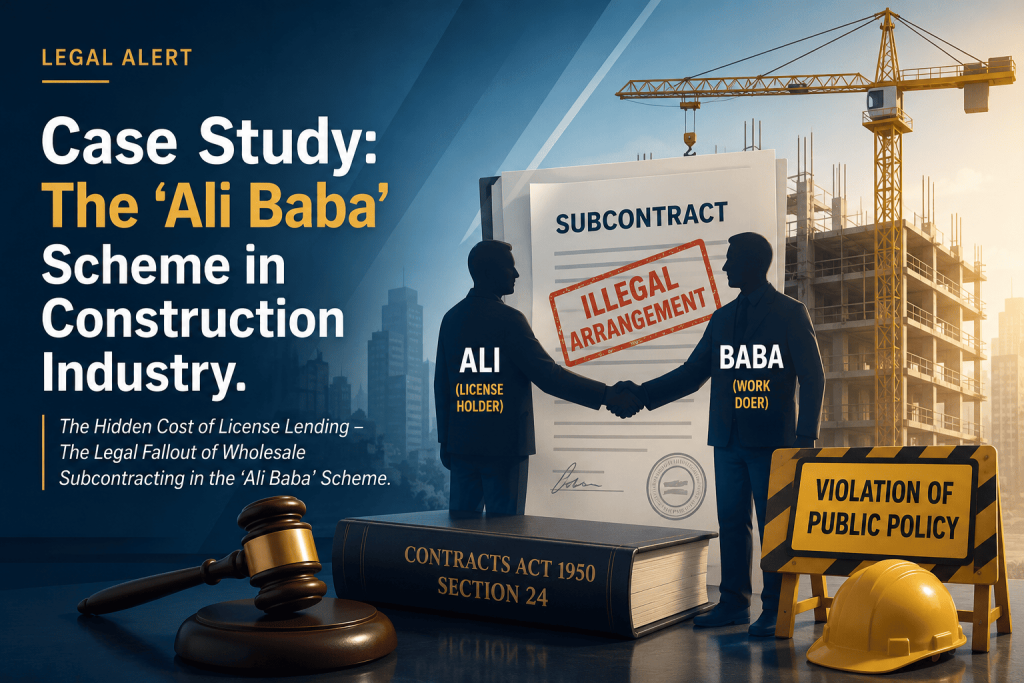
In Malaysia’s construction industry, many people have heard of the term “Ali Baba” arrangement.
Generally, it refers to a situation where a contractor who holds the necessary Bumiputera licence or government project eligibility (“Ali”) allows another company (“Baba”) to use that licence to obtain a government contract. The second company then carries out most or all of the construction work while the licensed contractor receives a fee for lending its credentials.
Some businesses have treated this as a common industry practice. However, a recent High Court decision has made one thing very clear: If the arrangement is illegal, the courts may refuse to help either party recover their money.
What happened?
In Alor Setar Development Corporation Sdn Bhd v EE Engineering (Malaysia) Sdn Bhd [2026] MLJU 2170, a Bumiputera contractor obtained a government construction project. It later entered into a subcontract with a non-Bumiputera company. After the project was completed, the subcontractor claimed that more than RM538,000 remained unpaid. The dispute eventually reached the High Court.
Why did the Court reject the claim?
The Court looked beyond the written subcontract and examined what actually happened in practice.
The evidence showed that:
- the licensed contractor did not perform any construction work;
- it did not contribute technical expertise;
- it did not bear any financial risk; and
- it merely received a fixed 2% licence fee.
The Court concluded that the arrangement was not a genuine subcontract.
Instead, it was a mechanism for lending the contractor’s licence to secure a government project.
Because the arrangement defeated government procurement policies, the Court held that it was illegal and contrary to public policy under Section 24 of the Contracts Act 1950.
But the subcontractor completed the work…
One of the most striking aspects of the case was this:
The subcontractor had actually carried out the construction works.
Yet, it was still unable to recover the unpaid balance.
The reason is simple.
Malaysian courts generally do not enforce illegal contracts.
Once a contract is found to be illegal, the court will usually leave both parties where they are instead of helping one party recover its losses.
What lessons can businesses learn?
This decision is an important reminder for anyone involved in construction projects.
- A subcontract is not automatically valid.
Calling an agreement a “subcontract” does not make it legally enforceable.
The court will examine the actual commercial arrangement rather than just the document’s title.
- Licence lending carries serious legal risks.
If a contractor merely lends its licence without genuinely undertaking the contractual responsibilities, the arrangement may be challenged as an illegal “Ali Baba” scheme.
- Completing the work does not always guarantee payment.
Many businesses assume that once construction is completed, they are legally entitled to be paid.
This case shows that this assumption can be wrong if the underlying agreement is illegal.
Our thoughts
Every construction project has its own commercial structure, and not every subcontract is an “Ali Baba” arrangement.
However, businesses should carefully review whether their contractual arrangements genuinely reflect the work, responsibilities and risks undertaken by each party.
Trying to shortcut procurement requirements may expose both contractors and subcontractors to significant legal and financial consequences.
Obtaining proper legal advice before entering into a construction arrangement is often far less costly than dealing with a dispute after the project has been completed.
Disclaimer: This article is intended for general information only and does not constitute legal advice. Specific legal advice should always be obtained based on the facts of each individual case.